
In recent years, generative artificial intelligence has become a powerful tool across industries — including personal investment management in the U.S. and Canada. Investors are using smart technologies to process information, optimize portfolios, and make data-driven decisions.
As access to AI tools expands, these innovations are transforming how people manage their wealth. Generative AI uses algorithms to detect patterns and predict market trends quickly and accurately. This helps investors and advisors analyze large amounts of data, uncover valuable insights, and make more strategic financial choices.
The role of AI in modern wealth strategies
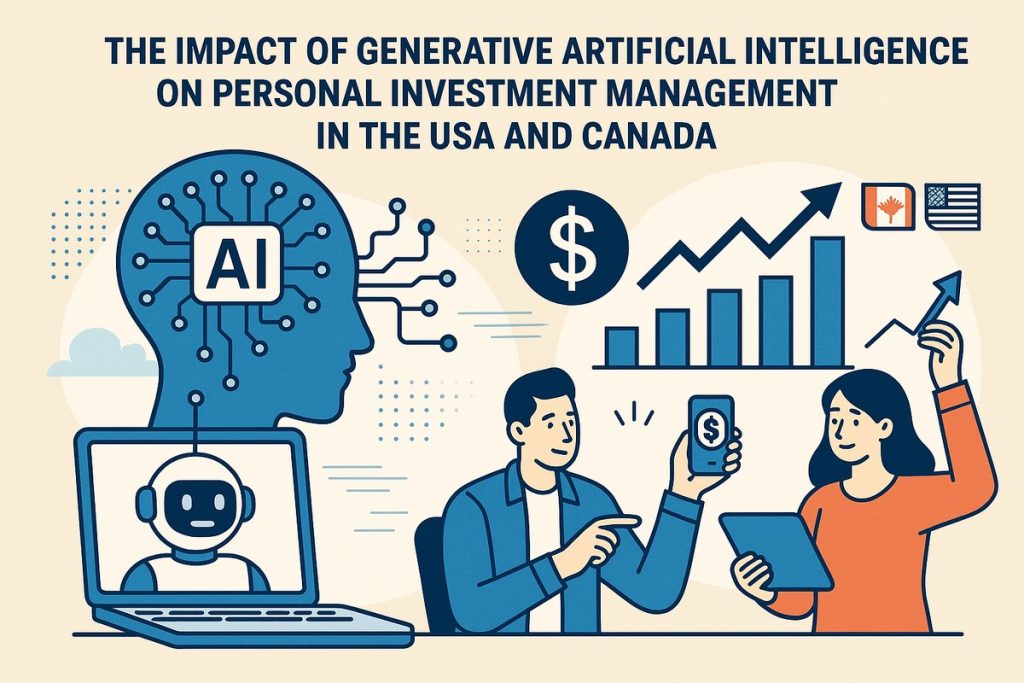
The integration of AI into personal finance is revolutionizing modern wealth strategies. Machine learning models, for instance, are able to analyze historical data and predict future movements, thus providing valuable forecasts. By leveraging AI, investors can enhance their decision-making processes and allocate assets more effectively. In the U.S. and Canada, where the financial landscapes are highly dynamic, such intelligence is crucial for sustaining competitive advantage.
Moreover, AI-powered tools streamline the investment process by automating routine tasks, reducing the time consumed in managing portfolios manually. From rebalancing portfolios to tax optimization, these tools can manage various facets of investment management, allowing individuals to focus on strategy rather than administration.
Automated financial advisors
One of the more practical applications of AI in investment management is the rise of robo-advisors. These automated platforms provide personalized investment strategies based on an individual’s risk tolerance and financial goals. By utilizing generative AI, these advisors can simulate a variety of market scenarios, helping users make better-informed decisions without the steep costs associated with traditional financial advisors.
Robo-advisors also offer the advantage of continuous portfolio monitoring, ensuring that investments are on track to meet set objectives. In the U.S. and Canada, where markets are continually evolving, having such vigilance can be a game changer for both novice and seasoned investors alike.
Challenges and ethical considerations in AI-driven investing
Despite the benefits, the rise of AI in investment brings about several challenges and ethical considerations. Data privacy is a significant concern, especially with the amount of information AI systems must process. Ensuring that sensitive data is handled responsibly and securely remains paramount as technology becomes more ingrained in financial systems.
Furthermore, transparency is crucial in AI-driven investing. Investors need to understand how AI tools generate recommendations and predictions, as blind reliance on algorithms without comprehension of underlying mechanisms may lead to unforeseen risks. Regulations must evolve to address these challenges, providing safeguards for investors and ensuring the integrity of financial markets.
Practical tips for integrating AI into personal finance
To effectively integrate AI into investment strategies, investors should start by identifying specific financial goals and risk levels. This will aid in selecting the appropriate AI tools that align with their individual needs. Additionally, educating oneself on the technology and staying informed about advancements can enhance decision-making and investment success.
Maintaining a balance between human insight and technological assistance is crucial. While AI can provide valuable insights, human judgment is irreplaceable, especially in interpreting nuanced information. By combining the strengths of both, investors can create a more resilient and adaptable investment strategy.
Conclusion
The impact of generative artificial intelligence on personal investment management is undeniable, offering individuals new ways to manage and grow their wealth. As the technology continues to evolve, its role in informing and shaping investment decisions will expand further. Investors in the U.S. and Canada must remain proactive, staying abreast of technological advancements to fully capitalize on the benefits AI offers.
By navigating ethical considerations and merging AI capabilities with human insight, personal finance management can become more efficient and effective than ever before. As information drives change, embracing this technological shift can unlock boundless potential for growth in the financial landscape.
